Newton's Three Laws of Motion Explained With Examples
Understand Newton's three laws of motion with everyday examples, the force equation F = ma, free-body diagrams and a worked problem.
Motion is not explained by speed alone. To understand why an object speeds up, slows down or changes direction, we need to look at the forces acting on it. Newton's three laws of motion give us a framework for doing exactly that.
First, what is a force?
A force is a push or pull that can change an object's motion or shape. Force is a vector, which means it has both magnitude and direction. Its SI unit is the newton (N). Several forces can act on the same object at once, so what matters for acceleration is the net force: the vector sum of all external forces.
1. Newton's first law: the law of inertia
An object remains at rest, or continues moving with constant velocity in a straight line, unless acted on by a non-zero net external force. This tendency to resist a change in motion is called inertia.
Imagine a book resting on a table. It does not start sliding because the forces on it are balanced: gravity pulls downward, while the table pushes upward with an equal normal force. The net force is zero, so its acceleration is zero.
Now imagine a bus moving forward that brakes suddenly. Your body tends to keep its previous motion, so relative to the bus you move forward. The bus changes its velocity; your body resists that change. A seat belt provides the force that helps slow you with the vehicle.
Important: zero net force does not always mean an object is stationary. It may be moving at a constant velocity. Balanced forces mean zero acceleration, not necessarily zero speed.
2. Newton's second law: net force causes acceleration
The acceleration of an object depends on the net force acting on it and its mass. For a constant-mass object, the familiar equation is:
This equation tells us two things. For the same mass, a larger net force produces a larger acceleration. For the same net force, a larger mass produces a smaller acceleration. Acceleration points in the direction of the net force.
Worked example: A 4 kg trolley experiences a net forward force of 12 N. Find its acceleration.
- Write the known values: m = 4 kg and Fnet = 12 N.
- Start with Fnet = ma.
- Rearrange: a = Fnet / m.
- Substitute: a = 12 / 4 = 3 m/s² forward.
Be careful with the word net. If a trolley is pushed forward with 20 N while friction acts backward with 8 N, the net horizontal force is 20 − 8 = 12 N, not 20 N.
3. Newton's third law: forces come in pairs
When object A exerts a force on object B, object B simultaneously exerts a force of equal magnitude and opposite direction on object A. These are called an action-reaction pair.
When you walk, your foot pushes the ground backward. The ground pushes your foot forward, helping you move. A rocket pushes exhaust gases backward; the gases exert a forward force on the rocket. The forces are equal and opposite, but they act on different objects.
This last point resolves a common confusion. Action and reaction forces do not cancel each other on one object because they act on two different objects. To find the net force on a single object, include only the forces acting on that object.
4. How to draw a free-body diagram
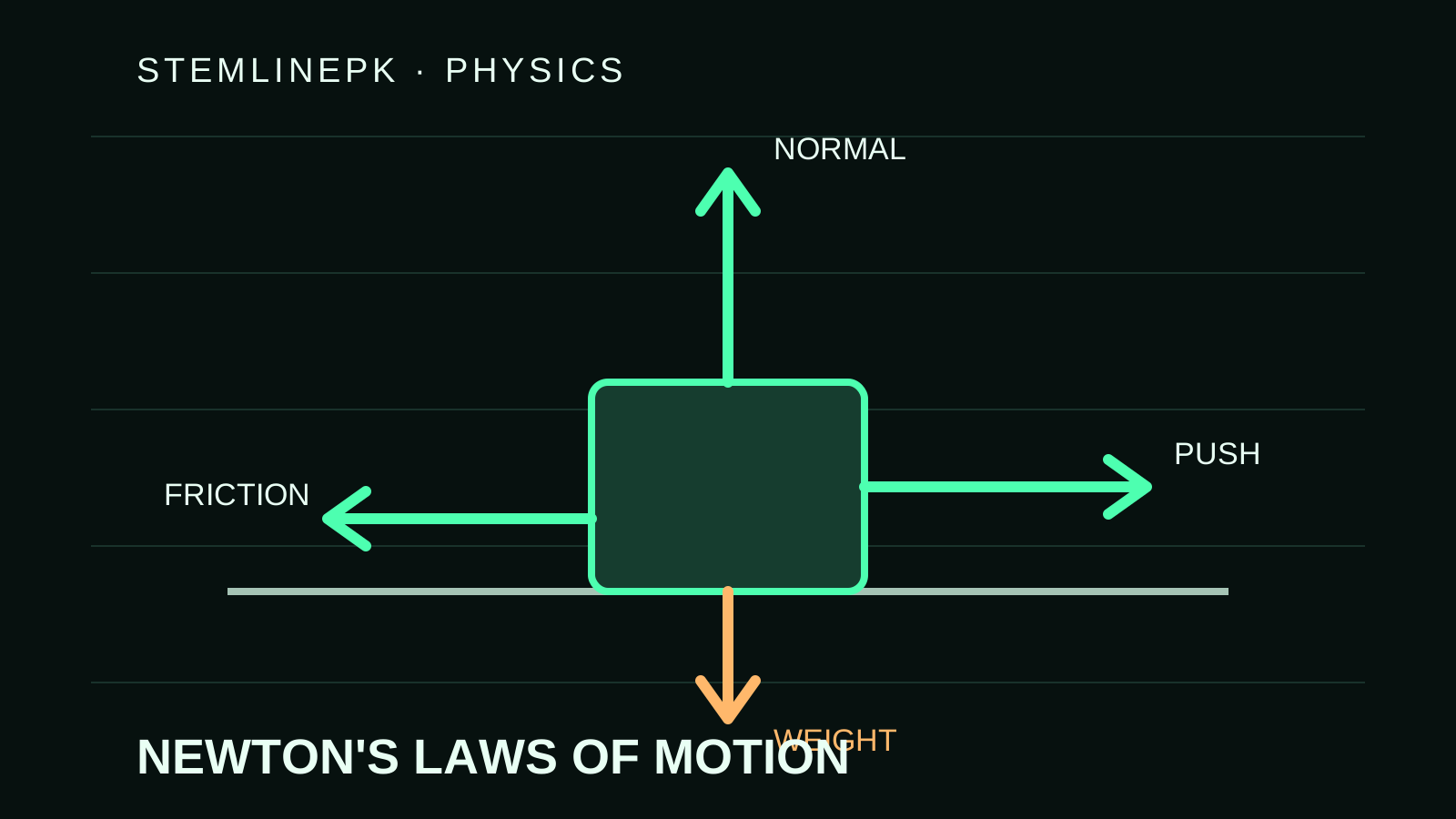
A free-body diagram isolates one object and shows the external forces acting on it as labelled arrows. It is one of the most useful habits in mechanics because it stops you from mixing forces acting on different objects.
- Choose the object you are analysing and represent it as a box or dot.
- Draw one arrow for each external force acting on that object.
- Label each arrow: weight, normal force, tension, friction or applied force, as appropriate.
- Choose positive directions and resolve angled forces into components if needed.
- Add the forces along each axis to find the net force, then apply Newton's second law.
Do not draw the object's velocity or acceleration as a force. They describe motion, not interactions. Also, do not draw the reaction force from a different object on the same free-body diagram.
5. How the three laws work together
Consider a box pushed across a rough floor. The first law tells you that if the push and friction balance, the box can continue at constant velocity. The second law tells you that if the push becomes larger than friction, the unbalanced force accelerates the box. The third law explains the interaction between your hand and the box: your hand pushes the box, and the box pushes your hand back.
The laws are not three unrelated facts. They form one consistent way to describe interactions and changes in motion.
Common misconceptions
- "An object needs a force to keep moving." Not if it is moving at constant velocity with zero net force. Friction often makes everyday objects slow down, which can hide this idea.
- "The biggest force is the net force." Net force is the vector sum of all forces, including those acting in the opposite direction.
- "Action and reaction cancel." They act on different objects, so they do not cancel on one object's free-body diagram.
- "Mass and weight are the same." Mass measures inertia and is measured in kilograms; weight is the gravitational force on an object and is measured in newtons.
Test your understanding
- A car travels in a straight line at constant speed. What is its net force?
- A 2 kg object has a net force of 10 N acting on it. What is its acceleration?
- When you push a wall, what is the Newton's third-law partner to the force of your hands on the wall?
Answers: (1) Zero, because its velocity is constant. (2) 5 m/s² in the direction of the net force. (3) The wall's force on your hands, equal in magnitude and opposite in direction.
Continue with STEMLinePK's mechanics notes for worked examples, an interactive graph, flashcards and a quiz. You can also find board-specific material through the Learn library and O Level Physics practice questions.
Further reading
- OpenStax: Force and free-body diagrams.
- OpenStax: Newton's second law.
- Khan Academy: Forces and Newton's laws of motion.
Whenever a motion problem feels confusing, start by choosing the object, drawing the forces on it, and finding the net force. The equations become much easier once the physical situation is clear.