How to Solve Quadratic Equations: 4 Methods With Examples
Learn how to solve quadratic equations by factoring, square roots, completing the square and the quadratic formula, with worked examples and common mistakes.
A quadratic equation is an equation in which the highest power of the variable is 2. You have probably seen equations such as x² + 5x + 6 = 0. The goal is to find the value or values of x that make the equation true.
There is more than one way to solve a quadratic equation. The useful skill is not memorising four procedures separately; it is recognising which method makes a particular equation easiest to solve.
1. Put the equation in standard form
The standard form is ax² + bx + c = 0, where a, b and c are numbers and a cannot be zero. Before solving, move every term to one side and simplify. Then identify the coefficients carefully, including their signs.
For example, in 2x² − 3x = 5, subtract 5 from both sides: 2x² − 3x − 5 = 0. Here a = 2, b = −3 and c = −5. A common error is to record b as positive 3 just because the term contains a subtraction sign.
2. Solve by factoring
Factoring rewrites the quadratic as a product of two simpler expressions. The key idea is the zero-product property: if two factors multiply to give zero, at least one factor must be zero.
Example: x² + 5x + 6 = 0
- Find two numbers whose product is 6 and whose sum is 5. They are 2 and 3.
- Rewrite the expression as (x + 2)(x + 3) = 0.
- Set each factor equal to zero: x + 2 = 0 or x + 3 = 0.
- Solve: x = −2 or x = −3.
Check by substitution if you are unsure. Both values make the original expression equal zero. Factoring is usually the fastest method when the factors are simple integers. It may be awkward when the roots are fractions or irrational numbers.
3. Solve using square roots
Use this method when the equation can be rearranged into a squared expression equal to a number. Isolate the squared term first, then take both the positive and negative square roots.
Example: 3x² = 27
- Divide both sides by 3: x² = 9.
- Take square roots of both sides: x = ±√9.
- Therefore, x = 3 or x = −3.
The ± sign matters. Writing only x = 3 would leave out a valid solution. If the equation is (x − 4)² = 16, take the square root to get x − 4 = ±4, giving x = 8 or x = 0.
4. Solve by completing the square
Completing the square turns part of a quadratic expression into a perfect square. It is useful for understanding where the quadratic formula comes from and for equations that are easy to rearrange into this form.
Example: x² + 6x + 5 = 0
- Move the constant: x² + 6x = −5.
- Take half the coefficient of x: 6 ÷ 2 = 3. Square it: 3² = 9.
- Add 9 to both sides: x² + 6x + 9 = 4.
- Factor the left side: (x + 3)² = 4.
- Take square roots: x + 3 = ±2.
- So x = −1 or x = −5.
Why add the same number to both sides? Because an equation stays balanced only when you make the same change to each side. The added 9 is exactly what turns x² + 6x into (x + 3)².
5. Solve using the quadratic formula
The quadratic formula works for every quadratic equation with real coefficients, including ones that do not factor neatly:
Example: 2x² + 3x − 2 = 0
- Identify a = 2, b = 3 and c = −2.
- Substitute: x = [−3 ± √(3² − 4(2)(−2))] / [2(2)].
- Simplify inside the square root: 9 + 16 = 25.
- x = (−3 ± 5) / 4.
- First solution: (−3 + 5)/4 = 1/2. Second solution: (−3 − 5)/4 = −2.
The solutions are x = 1/2 and x = −2. Notice that the ± creates two separate answers. Keep the denominator 2a under the entire numerator, not just under the square-root term.
6. What the discriminant tells you
The expression under the square root, b² − 4ac, is called the discriminant. Its value tells you how many real solutions the equation has:
- If b² − 4ac is positive, there are two distinct real solutions.
- If it is zero, there is one repeated real solution.
- If it is negative, there are no real solutions (there are two complex solutions).
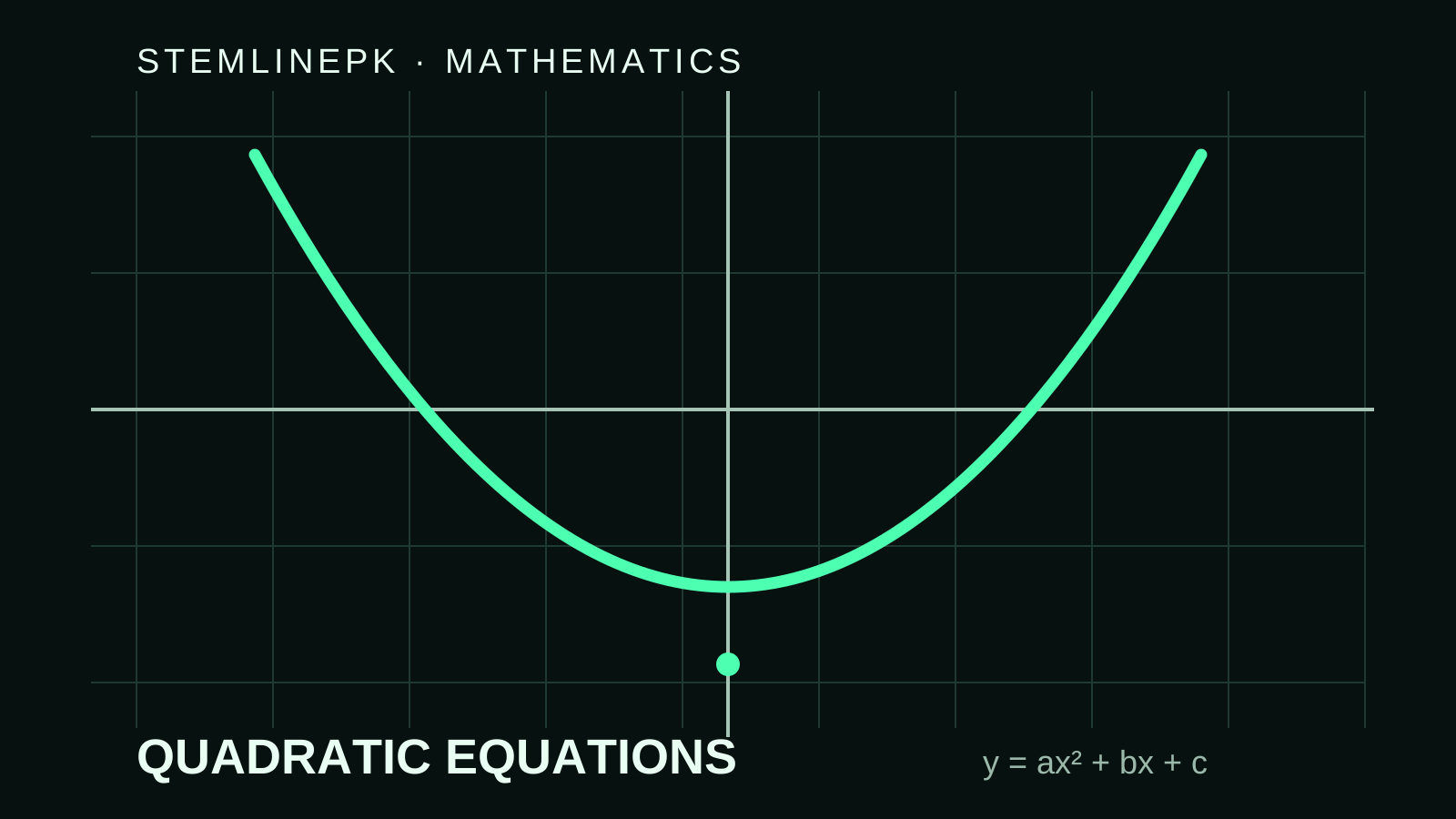
This is useful before doing all the calculations: it tells you what kind of answer to expect. It also connects the algebra to the graph. A quadratic graph is a parabola; its real roots are the points where the graph crosses or touches the x-axis.
7. Which method should you choose?
- Try factoring when the numbers look friendly and the factors are easy to spot.
- Use square roots when the equation already contains a squared expression or can be rearranged into one.
- Complete the square when the structure makes it convenient or when you need vertex form.
- Use the quadratic formula when factoring is not straightforward or when you want a method that always works.
You do not need to force every equation into the same method. Choose the one that keeps the working clear and reduces avoidable arithmetic.
Common mistakes to avoid
- Not moving every term to one side before identifying a, b and c.
- Dropping a negative sign when substituting b or c.
- Forgetting the ± when taking square roots or using the quadratic formula.
- Putting only part of the numerator over 2a.
- Stopping after finding one root, even though a quadratic can have two.
- Rounding too early. Keep exact values until the final step if the question asks for an exact answer.
Practise the methods
Try these without looking at a worked solution: (1) x² − 7x + 12 = 0; (2) 5x² = 45; (3) x² + 4x − 1 = 0. Check your answers by substituting them into the original equation.
For a full lesson with worked notes, an interactive graph, flashcards, exam-style questions and a quiz, continue to STEMLinePK's quadratic equations notes. You can also explore the free Mathematics learning library.
Further reading
- OpenStax: Solving quadratic equations using the quadratic formula.
- Khan Academy: Quadratic equations and functions.
Quadratic equations become much easier when you first identify their structure, then choose a method deliberately. Practise all four approaches, and you will start recognising the quickest route rather than guessing which formula to use.