Derivatives Explained: Meaning, Rules and Worked Examples
Understand what a derivative means, how it measures slope and rate of change, and how to differentiate functions using essential rules and worked examples.
A car's speed changes as it accelerates. A curve becomes steeper as you move along it. A population may grow faster at one moment than another. These situations have something in common: we want to know how quickly one quantity is changing at a particular instant. In calculus, the tool for answering that question is the derivative.
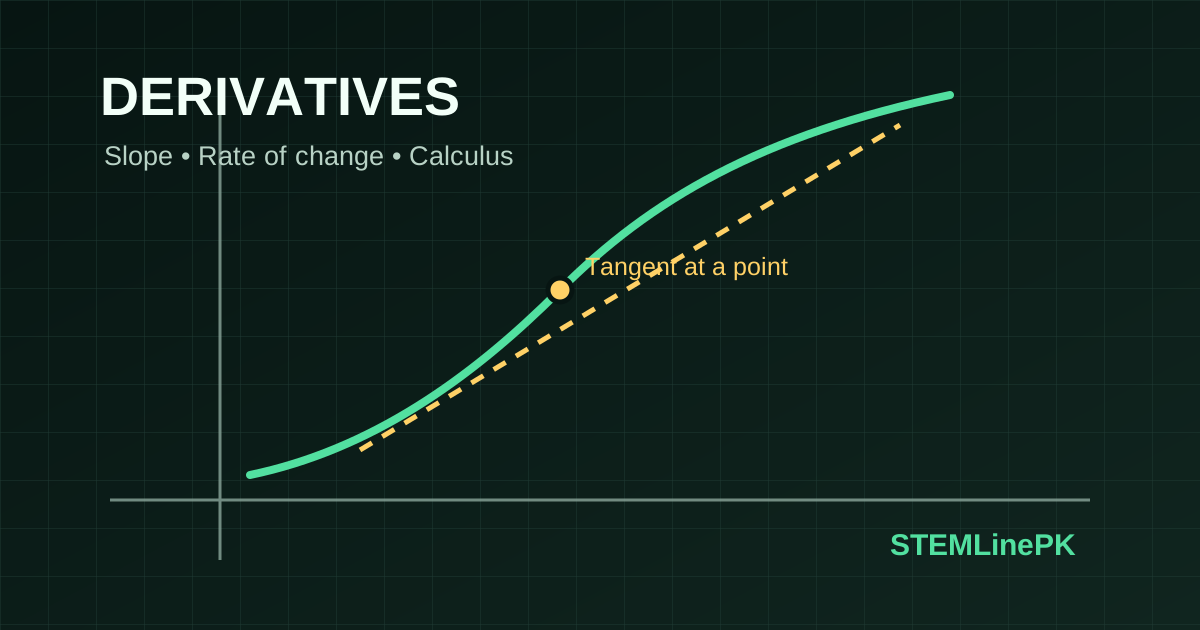
A derivative tells us the instantaneous rate of change of a function. Geometrically, it gives the gradient of the tangent line to a graph at a chosen point. This guide builds the idea from the ground up, then works through the rules you will use most often.
1. What does a derivative actually tell us?
Suppose a function describes the position of a moving object over time. Its average rate of change over a time interval tells us how much the position changed divided by how much time passed. That is average velocity. But what if we want the velocity at one exact instant? We make the time interval smaller and smaller. The value approached by the average rate of change is the instantaneous rate of change — the derivative.
The same idea applies beyond motion. If C(x) describes the cost of producing x items, then C'(x) describes how quickly cost is changing as production increases. If f(x) describes a graph, then f'(x) tells us its slope at each input.
2. The derivative as the slope of a tangent
You may already know how to calculate the gradient of a straight line: change in y divided by change in x. A curve is different because its slope usually changes from point to point. We can still find the slope at one point by drawing a tangent — a straight line that touches the curve there and has the same local direction.
Imagine drawing a secant line through two nearby points on the curve. Its gradient is an average rate of change. Move the second point closer to the first, and the secant line approaches the tangent. The limiting gradient is the derivative at that point.
For a function y = f(x), the derivative is commonly written as f'(x), dy/dx or d/dx[f(x)]. These notations all describe differentiation: finding the derivative of a function.
3. The limit definition of a derivative
The formal definition uses a limit. Start at x, then move a small horizontal distance h to x + h. The change in the function's output is f(x + h) − f(x), while the change in input is h. Their ratio is the gradient of a secant line.
We do not simply put h = 0 into the fraction, because that would make the denominator zero. Instead, we simplify the expression first and then evaluate the limit. This is the mathematical step that turns an average rate of change into an instantaneous one.
Worked example: Find the derivative of f(x) = x² using the definition.
- Write the definition: f'(x) = limh → 0 [f(x + h) − f(x)] / h.
- Substitute f(x) = x²: f'(x) = limh → 0 [(x + h)² − x²] / h.
- Expand: (x + h)² = x² + 2xh + h².
- Subtract x² and simplify: (2xh + h²) / h = 2x + h.
- Now take the limit as h approaches zero: f'(x) = 2x.
Therefore, the derivative of x² is 2x. Notice what this means: the slope is not one fixed number. At x = 1 the slope is 2; at x = 3 the slope is 6; at x = 0 the slope is 0.
4. Essential differentiation rules
The limit definition explains where derivatives come from, but applying it from scratch to every function would be slow. Differentiation rules give us shortcuts that have been proved using the definition.
The power rule
For a power of x, multiply by the exponent and then reduce the exponent by one:
For example, if y = x⁵, then dy/dx = 5x⁴. If y = x³, then dy/dx = 3x². The exponent becomes the coefficient, and the new exponent is one less.
The constant rule
A constant function has a horizontal graph, so its slope is zero. Therefore, the derivative of any constant is zero: d/dx(c) = 0. For example, the derivative of 12 is 0.
The constant multiple and sum rules
A constant multiplier stays in front when you differentiate. You can also differentiate each term of a sum or difference separately.
Worked example: Differentiate y = 4x³ − 5x² + 7x − 9.
- Differentiate each term separately.
- 4x³ becomes 12x².
- −5x² becomes −10x.
- 7x becomes 7, and the constant −9 becomes 0.
- So dy/dx = 12x² − 10x + 7.
The product rule
When two functions are multiplied, do not simply differentiate each one and multiply the results. Use the product rule:
In words: differentiate the first function and leave the second unchanged, then add the first unchanged multiplied by the derivative of the second.
Example: Differentiate y = x² sin x. Let u = x² and v = sin x. Then u' = 2x and v' = cos x. Applying the rule gives dy/dx = 2x sin x + x² cos x.
The quotient rule
For one function divided by another, use:
A useful way to remember the order is: bottom times derivative of top, minus top times derivative of bottom, all over bottom squared.
The chain rule
The chain rule is used when one function is inside another. For example, (3x + 1)⁴ has an outer power function and an inner function, 3x + 1. Differentiate the outside first, keep the inside, then multiply by the derivative of the inside.
Worked example: Differentiate y = (3x + 1)⁴.
- Differentiate the outer power: 4(3x + 1)³.
- Differentiate the inside expression 3x + 1: its derivative is 3.
- Multiply: dy/dx = 12(3x + 1)³.
5. What does the sign of a derivative tell you?
The derivative gives the slope of the graph, so its sign tells you the direction in which the function is moving locally:
- If f'(x) is positive, the function is increasing at that point.
- If f'(x) is negative, the function is decreasing at that point.
- If f'(x) is zero, the tangent is horizontal. The point may be a local maximum, a local minimum or a stationary point that is neither.
A zero derivative does not automatically mean a maximum or minimum. For example, y = x³ has derivative 3x², which is zero at x = 0, but the function continues increasing through that point. You need more information — such as the behaviour of the derivative on either side — to classify a stationary point.
6. Common mistakes to avoid
- Reducing the exponent without first multiplying by the original exponent.
- Forgetting that the derivative of a constant is zero.
- Applying the power rule to a product or quotient as if it were a single power.
- Forgetting to multiply by the derivative of the inside function when using the chain rule.
- Assuming that f'(x) = 0 always means a maximum or minimum.
- Confusing the value of f(x), which gives the height of the graph, with f'(x), which gives its slope.
7. Test your understanding
Try these questions before checking the answers. Show the steps rather than relying only on the final result.
- Differentiate y = 7x⁴ − 3x² + 8.
- Differentiate y = (2x − 5)³.
- Differentiate y = x³ cos x.
- If f'(x) is negative throughout an interval, what is happening to f(x) on that interval?
Answers: (1) 28x³ − 6x. (2) 6(2x − 5)². (3) 3x² cos x − x³ sin x. (4) The function is decreasing throughout that interval.
For more calculus material, continue to STEMLinePK's calculus notes, or explore the free Mathematics learning library for related topics and practice.
Further reading
The central idea is simple: a derivative tells you how quickly a function changes at a particular point. Once that meaning is clear, the rules become tools for calculating the slope and rate of change of increasingly complicated functions.